Patent Research & FTO
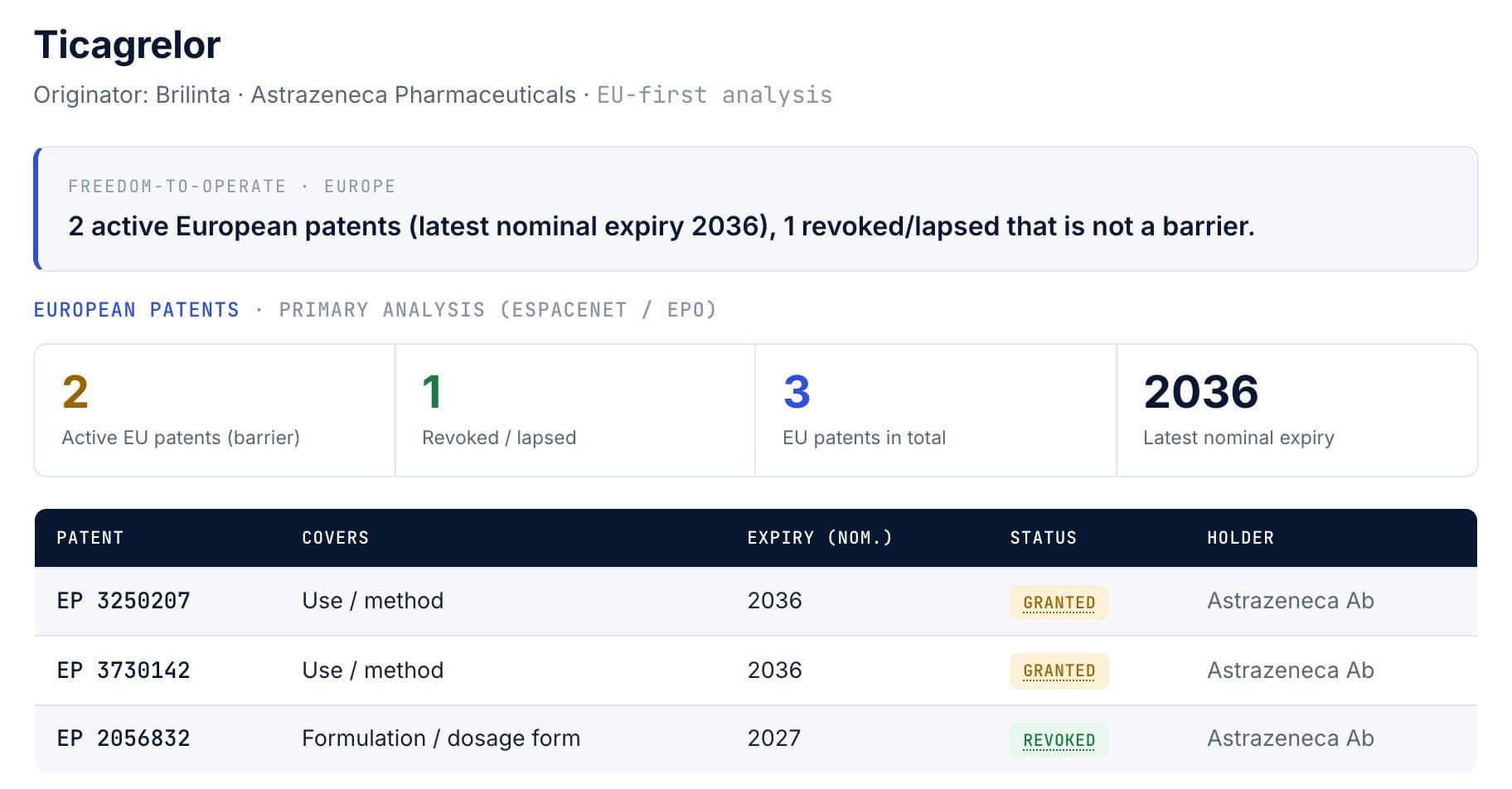
Ticagrelor, one search: two European patents still stand until 2036, one has been revoked.
The situation
How this used to work
A generics manufacturer picks its next product by working out which patents on the original still stand, which have been revoked, and when the last one runs out. Move too early and you face an infringement case. Move too late and competitors are already on the shelf.
The information is public. It is also spread across separate registries, in different formats, with legal statuses that change over time. Answering the question properly means reading hundreds of records to find the few that matter.
One specialist did this by hand, product by product, and the work started again with every new candidate molecule.
What we built
The system
A patent evaluation tool for pharmaceutical R&D. Type a molecule name and it returns the European landscape first: which patents block, what each one covers, whether it is still in force and the year the last one runs out. The US and the rest of the world follow as secondary territories.
Every source is free and public, so the tool sits on the open web and never touches confidential data. Each line of the answer can be checked against the registry it came from, which is what makes it usable for an R&D lead. It runs in English and Greek, and anyone can try it.
How it works
The pipeline, step by step
A molecule name is the only input
The tool works out the other names and salt forms the same substance may be filed under, because a patent on a slightly different form of the molecule blocks a launch just as completely. Anyone on an R&D team can run it without patent training.
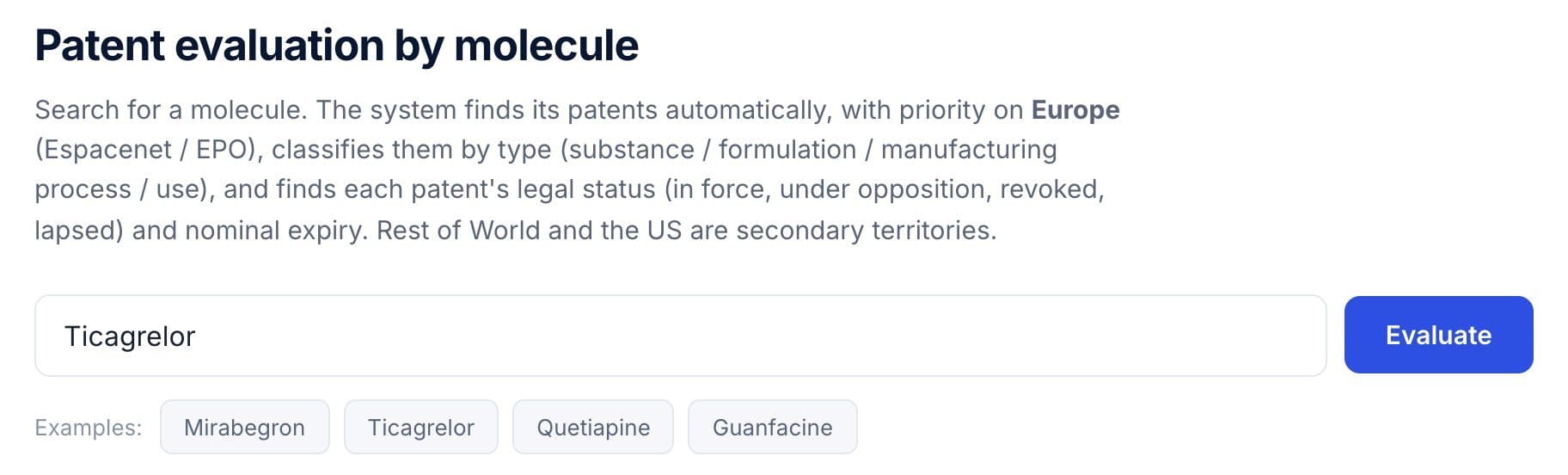
The whole input is the name of the molecule.
The answer comes first as one sentence
For ticagrelor: two active European patents, the last one expiring in 2036, and one revoked patent that is no longer a barrier. A product manager can act on that line before reading any of the detail underneath it.
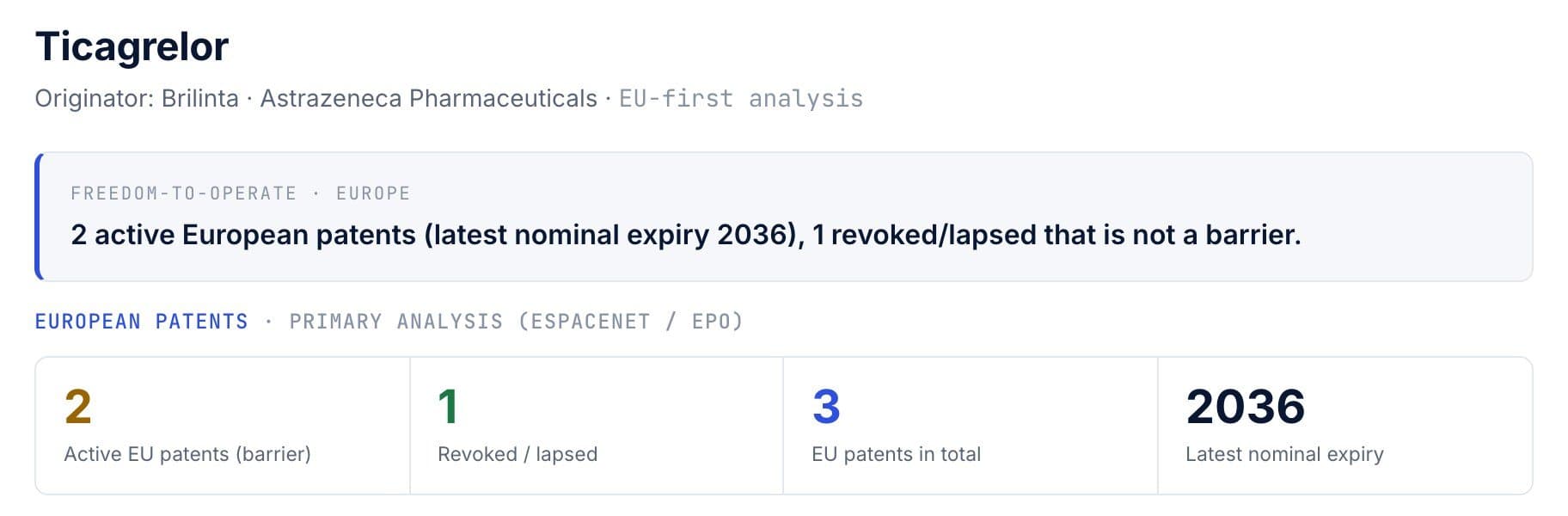
The decision in one sentence, with the counts behind it.
Each patent is labelled by what it covers
Substance, formulation, manufacturing process or use. The type decides the strategy: a process patent can often be designed around, while a substance patent usually has to be waited out. Revoked patents stay on the list, marked, so nobody mistakes them for a barrier.

Coverage, nominal expiry and live legal status for every European patent.
The map shows where else the same family is filed
A European patent is rarely filed in Europe alone. For ticagrelor the same families reach 23 more territories, from Brazil to Japan. For a company that exports, that map is the list of markets to check before planning a launch.
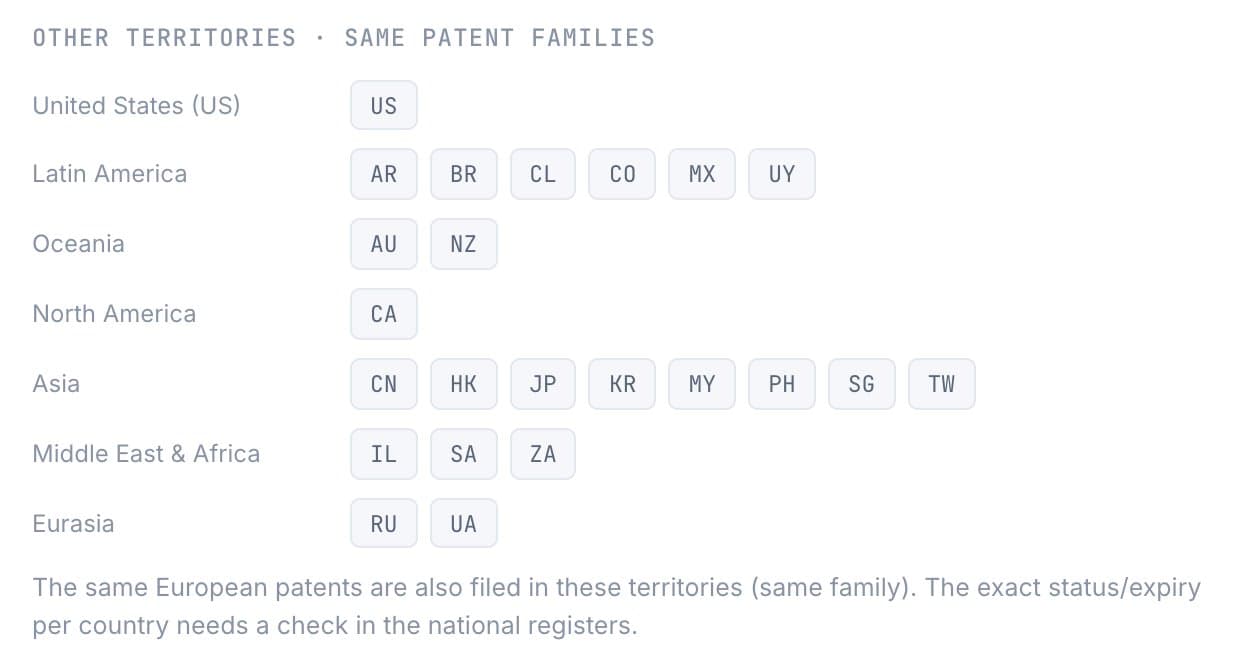
The same families, by region, outside Europe.
A broad search shows how crowded the field is
Next to the main analysis, a wide Espacenet search looks for formulation, process and use patents, including filings that exist only in Europe. For ticagrelor it found 462 records across five jurisdictions and sorted a sample of 25 by type. A specialist then decides which of them deserve a closer look.
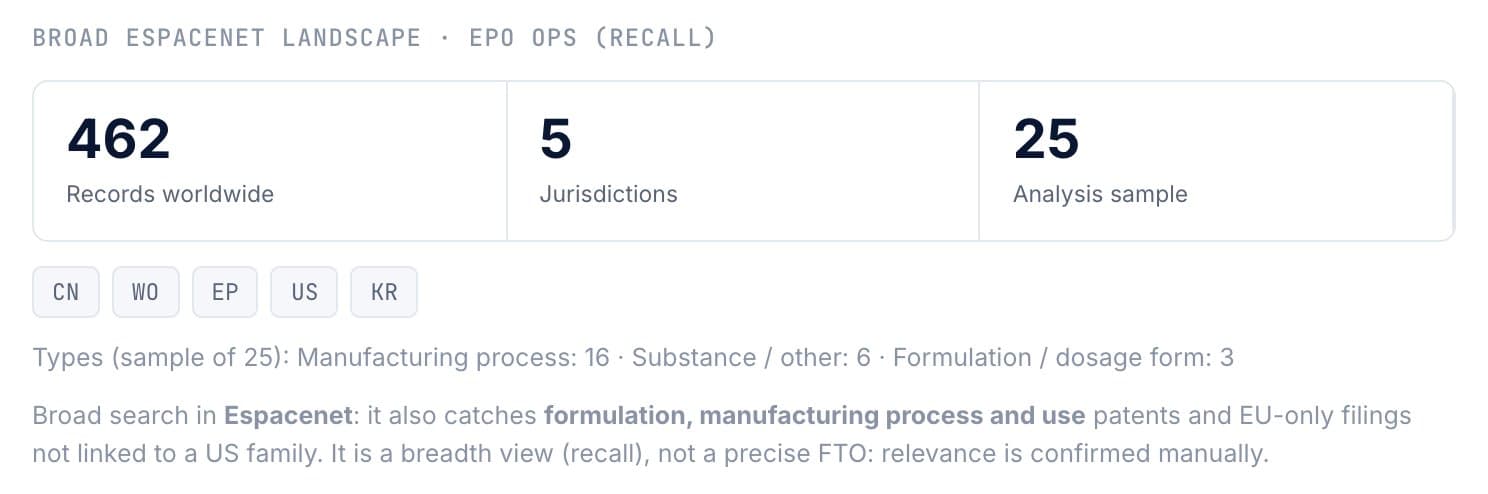
462 records worldwide for ticagrelor, with a sample sorted by type.
The tool says where its answer stops
Nominal expiry is the filing date plus twenty years. The real date in each country depends on renewals and extensions that only the national registries hold, and the tool states that on the page and in its PDF report. It speeds up the decision, and final freedom to operate is still confirmed with a patent attorney.
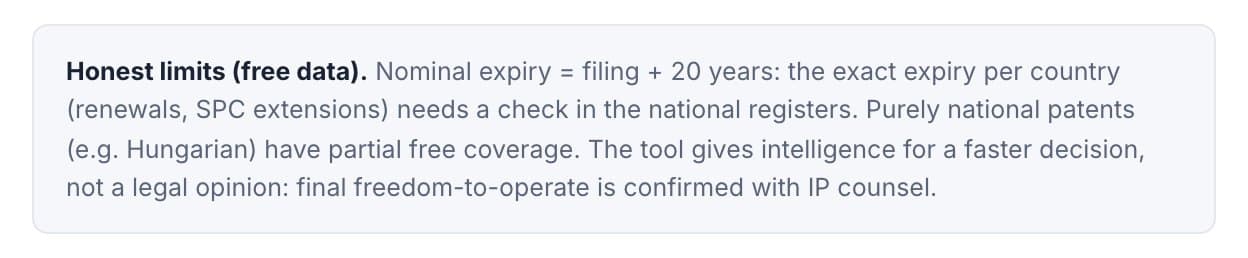
The limits of free data, written on the page.
What changed
The result
A first patent picture for a candidate molecule now takes one search. A team can bring it into the meeting where the product decision is made, and look at more candidates before committing budget to one.
The tool is live and open to anyone. Type a molecule and you see the same picture shown on this page.
462
worldwide records found by the broad search for one molecule
Measured, one evaluation of ticagrelor. The main analysis found 3 European patents, 2 of them in force.
Minutes
to a first answer on a new molecule
Estimate. Final freedom to operate is still confirmed with a patent attorney.
30+
molecules tested against the live registries
Tested during development, on the Europe-first version.
€0
in data costs
Every source is public: Espacenet from the European Patent Office and the FDA Orange Book.