The one term everyone in the market is using this year. Here's what it means for your business.
What is an AI agent? If you run a company, you've heard the phrase in a pitch this year, probably twice, and probably wrapped in enough jargon that you nodded and moved on. This guide unwraps it. By the end you'll know what an AI agent is, how it differs from the chatbot on your website, how one works without a single equation, and where it gives real hours back versus where it's still hype.
I'll write this the way I'd explain it to a friend who owns a business, not the way a vendor explains it to close you. That means plain words, clear limits, and concrete examples you can map to your own week.
The definition first, because most of the confusion lives there.
What is an AI agent, in plain English?
An AI agent is software that doesn't just answer you, it completes a task for you. It reads a request, looks things up, decides what to do next, takes the action, then checks its own result, all inside limits you set. An assistant hands you words. An agent finishes the errand.
That one difference is a bigger jump than it sounds.
The tools you've met so far mostly talk. You ask a question, they give you text, and you go do something with that text. An AI agent closes that last loop. Ask it to sort out a late delivery and it finds the order, checks the shipping status, drafts the customer reply, updates the record, and queues a follow-up for Thursday. You review, you approve, it's done. The talking was never the point. The doing is.
Anthropic, one of the companies building this technology, draws the line cleanly. In its engineering guide it defines agents as "systems where LLMs dynamically direct their own processes and tool usage, maintaining control over how they accomplish tasks," as opposed to fixed scripts that follow "predefined code paths." Read past the phrasing and it says something simple: an agent decides its own next step instead of running a route someone wired in advance. You can see the distinction in Anthropic's Building effective agents writeup.
Underneath, an agent runs on the same generative AI that powers ChatGPT and Claude, a large language model trained with machine learning on a vast amount of text, with two things added: a set of tools it's allowed to use, and a loop that lets it take more than one step. That's the whole technical story a business leader needs. The artificial intelligence part is the same; what changed is that it can now act.
★ Remember: the test for whether something is an AI agent isn't how smart it sounds. It's whether it takes actions on your behalf, or just hands you text to act on yourself.
This isn't a fringe idea anymore. According to the Stanford HAI AI Index 2025 report, 78% of organizations reported using AI in 2024, up from 55% the year before. Agents are where a lot of that spending is now heading, because answering questions was step one, and finishing tasks is the step that removes work from people's plates.
What are AI agents next to the tools you already know?
So what are AI agents compared to the chatbot on your site or the assistant you type into? The three get blurred together in marketing, and the difference decides if you're buying something useful or a fancier version of what you already have.
Three things sit on a spectrum, from least to most capable:
- A chat or assistant answers. You type, it replies, you take it from there. ChatGPT and Claude in their plain chat windows are this.
- A chatbot is a conversational front door, usually the widget on a website or help center. A good one answers from your company's real information. A bad one improvises.
- An AI agent acts. It doesn't stop at the reply. It looks up the data, updates the system, sends the message, and only pulls in a person for the calls that need one.
Here's the same thing as a table.
| AI chat / assistant | Chatbot | AI agent | |
|---|---|---|---|
| What it does | Answers questions, drafts text | Holds a conversation through a set interface | Completes a task from start to finish |
| Where you meet it | A box you type into | A widget on a website or help center | Behind the scenes, wired into your systems |
| Does it take action? | No, it hands you words | Rarely, it mostly replies | Yes: looks things up, updates records, sends the follow-up |
| Who does the next step | You | You, usually | The agent, then a person checks |
| A fair analogy | A sharp intern who drafts on request | A receptionist who fields common questions | A junior employee who finishes the errand |
Notice the pattern down that table. Each step to the right takes one more thing off your team's hands. The assistant saves you the writing. The chatbot saves you the answering. The agent saves you the doing. When a vendor says "agent" but the product only replies, they've sold you a chatbot with a better badge. The question to ask in the meeting is blunt: "After it understands the request, what does it do, and what does my team still have to do afterward?"
✓ Tip: if the answer to that question is "it drafts something and hands it back to you," it's an assistant or a chatbot. That's fine, those are useful. Just don't pay agent money for it.
How do AI agents work? The loop, without the math
How do AI agents work under the hood? You don't need the engineering, and anyone insisting you do is billing by the hour. An agent runs the same short loop a capable employee runs, over and over, until the job is done.
Perceive. It reads the request, in plain natural language, and gathers the context it needs. A customer email, an order record, your refund policy, whatever the task touches.
Decide. It picks the next step from the options it's allowed to take. Not any step, the ones you've given it. Look up the order. Draft the reply. Flag it for a human. This is the part that makes it an agent and not a script: it chooses, based on what it found, rather than following a fixed route.
Act. It does the step. Pulls the shipping status, writes the message, updates the field, sends the note.
Check. It looks at the result and decides whether the task is finished, needs another pass, or has hit something it shouldn't handle alone. When it's unsure, a well-built agent stops and hands off to a person instead of guessing.
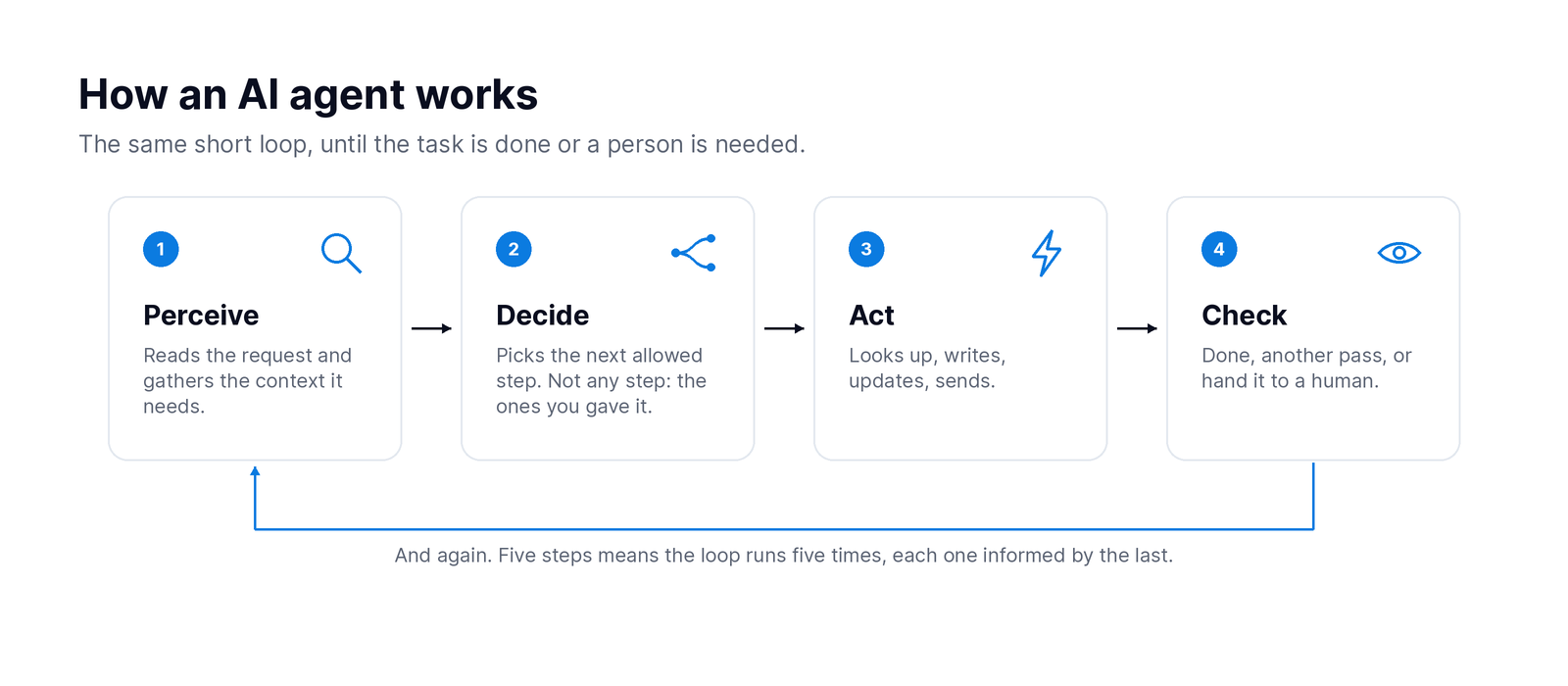 Perceive, decide, act, check. The same loop a good employee runs, just faster and without getting bored on the hundredth pass.
Then it repeats. A task with five steps means the loop runs five times, each step informed by the last. That's how an agent handles complex tasks: by breaking them into steps it can check. It's also the real difference from the automation you might already have. Traditional automation follows a rule you wrote in advance: "when a form comes in, send this exact email." It breaks the moment reality doesn't match the script. An agent handles the messy version, the email that arrives half in another language with the order number buried in the third sentence, because it works out each step as it goes.
⚠ Caution: more steps also means more places to go wrong. A small mistake in step two can compound by step five. This is exactly why bounded tasks and a human review step aren't optional extras. They're the thing that keeps a multi-step agent safe. We'll come back to it.
AI agents explained through four jobs you already pay for
Abstract definitions are easy to nod at and hard to act on. So here are AI agents explained the only way that helps a decision-maker: as concrete jobs, mapped to the four areas where nearly every business bleeds hours. These four are the functions we build agents for, because they're where the repetitive tasks in language and data pile up.
Sales. An agent reads an inbound inquiry, finds the matching product and price from your own catalog, drafts the quote, logs it in the CRM, and queues the follow-up so it doesn't slip. A salesperson approves before anything reaches the customer. What left the salesperson's plate wasn't the selling. It was the twenty minutes of paperwork around every deal.
Marketing. An agent drafts the week's posts and emails in your company's voice, adapts each one to its channel, and lines them up for a human to review and publish. Content stops happening in bursts "when things calm down," which they never do, and starts happening on a schedule.
Support. This is the one we know best. The support agents we build answer the routine customer questions automatically, pulled from the client's own documentation, day or night. The questions that need a person get routed to a person, instead of getting a confident made-up answer. Machines on repetition, people on judgment.
Operations. An agent moves data between the systems that don't talk to each other: email to the ERP, the ERP to the courier portal, the portal to a spreadsheet. Nobody plays human clipboard anymore, retyping the same order number into four screens.
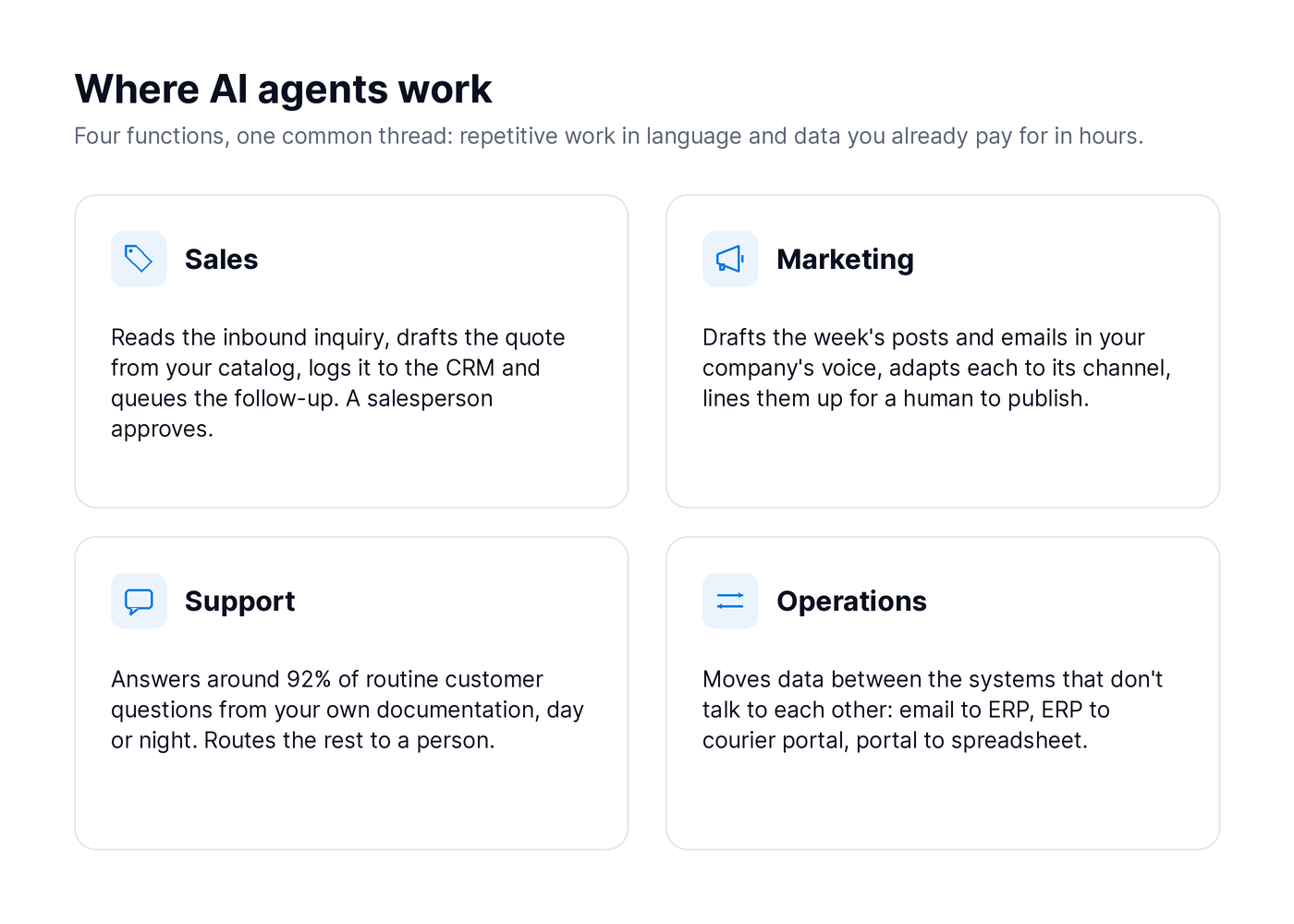 Four functions, one common thread: repetitive work in language and data that you're already paying for in hours.
If you want to see this stop being theory, open Claude or ChatGPT with its tools switched on and watch it handle a multi-step request in one go. It reads a vague customer message, works out which order it refers to from a list, and drafts the reply, without you feeding it each step. The screenshot below shows exactly that.
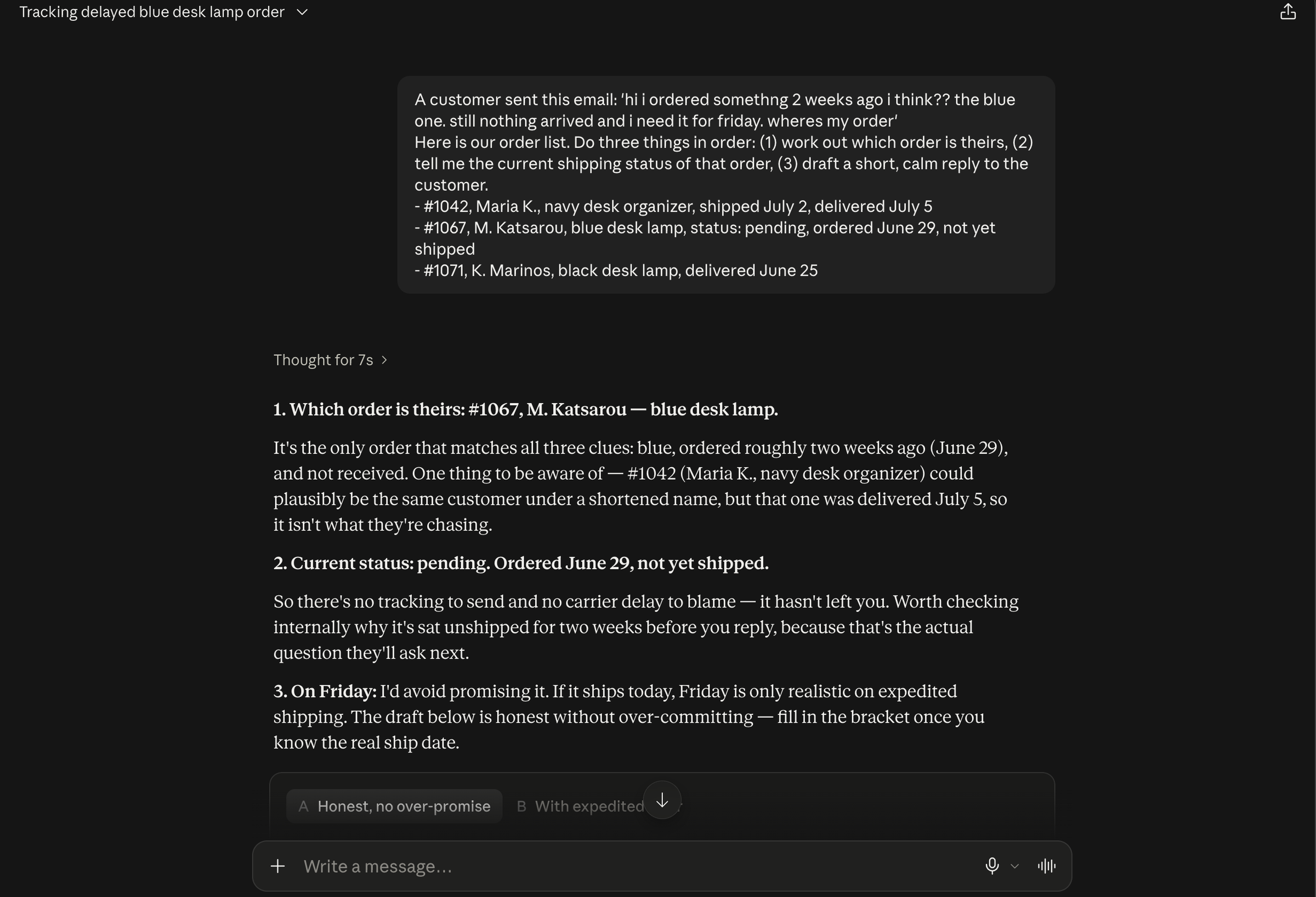 An AI agent working through a real multi-step task: figure out which order the customer means, then draft the response. No hand-holding between steps.
That's the thing to look for in any agent pitch: can it carry a task across several steps and stop when it should.
Where AI agents earn their keep
An AI agent pays off in the same place every time: high-volume, repetitive work that lives in text and data, where a knowledgeable person can check the output in under a minute. Get those three conditions and an agent gives hours back reliably. Miss one and you've bought a subscription you'll cancel.
Run any task in your business through this quick filter before you point an agent at it:
- It repeats, weekly at least. A task that happens twice a year isn't worth the setup, however annoying it is.
- It lives in language or data. Emails, documents, records, spreadsheet rows. If the work is reading, writing, or moving information, an agent can carry it. If it's mostly physical or political, it can't.
- Someone can verify the result fast. Quick checking is what keeps the whole thing safe. If reviewing the agent's work takes as long as doing it, you've automated nothing.
Do the arithmetic on one candidate with your own figures. If a proposal takes three hours and you send ten a month, that's thirty hours, most of a working week, spent restating things your company has written a hundred times. If your support inbox gets forty questions a day and thirty are the same eight questions in different words, that's a person's whole morning, every morning. An agent aimed at either one earns its keep by the end of the month.
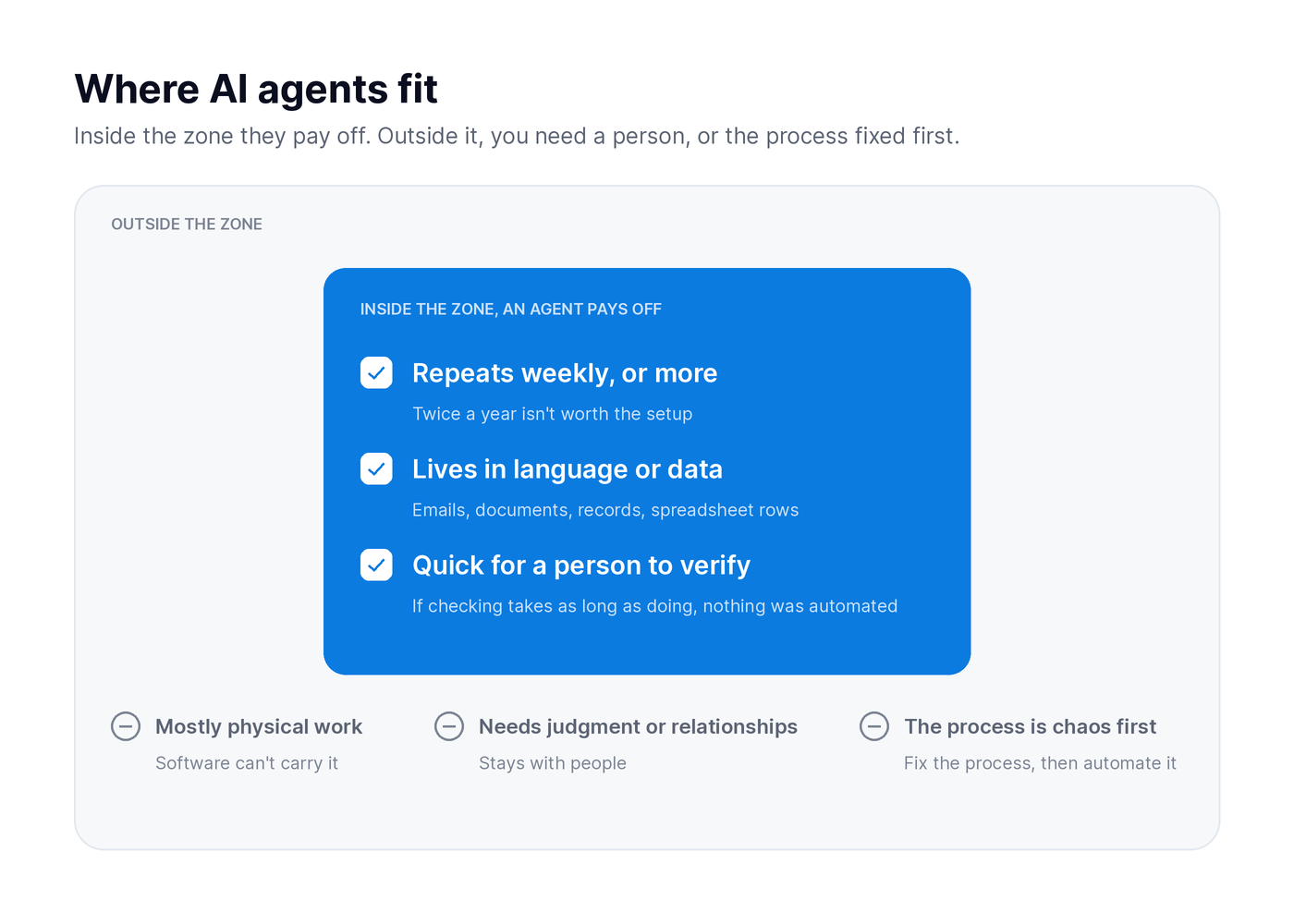 The green zone for AI agents: repetitive, language-based, quick to check. Everything outside it needs a person, or needs the process fixed first.
There's a compounding point here that most pitches skip. A discount you negotiate with a supplier saves you once. Thirty hours a month taken off proposal writing comes back every month, for as long as you send proposals, with no renegotiation. Recurring work deserves a recurring fix, which is also why an agent that runs continuously tends to beat a one-off project that goes stale.
The limits nobody puts on the sales page
The upside is real and it's narrower than the headlines. No fair answer to the question skips the failure modes, so here they are, plainly.
An agent amplifies your process, good or bad. If your quoting process is chaos, an agent produces chaos faster. In our experience the problem is rarely the AI. It's usually the process running alongside it. Sometimes the right first project is fixing the process, with no technology involved at all.
It's only as good as the data it can reach. An agent cut off from your real price lists, policies, and records will guess, and it guesses fluently and confidently, which is worse than guessing badly. Connecting it to your actual information is the step that separates a useful agent from an articulate stranger.
Multi-step means multi-step risk. Because an agent chains actions, a small error early can grow by the last step. Keep each agent's task bounded, give it clear limits on what it's allowed to do, and put a person on the results that matter. You'll also be pitched multi-agent systems, several agents handing work to each other. Impressive in a demo, and a lot more places to go wrong. Start with one agent on one task. Guardrails aren't a lack of ambition. They're what makes ambition safe.
Judgment and accountability stay human. An agent can draft the difficult email and even queue it. Whether to send it, and owning what happens next, is still your name on the door. Governance frameworks like the NIST AI Risk Management Framework exist precisely because responsibility can't be handed to software, no matter how capable.
Some companies shouldn't buy an AI agent yet, and no pricing page will tell you that. If your volume is genuinely low, if your processes live entirely in one person's head, or if nobody internally can own the project for even two hours a week, the right advice is to wait and fix those first. An agent multiplies what's already there. Multiply a mess and you get a bigger mess, faster.
I'd rather you read that now than discover it in month three of an invoice.
How to put your first AI agent to work
You've got the picture: what an AI agent is, how it works, where it pays and where it doesn't. Here's the first move, drawn from the projects that stick.
1. Pick one task, not a strategy. The failed projects start with "let's become an AI-driven company." The ones that work start with "quotes take three hours and they shouldn't." One task, high volume, low judgment.
2. Count its hours honestly. Ask the person who does the work, not the org chart. Hours per instance times instances per month. If the total doesn't make you wince, pick a different task.
3. Keep the agent on a leash at first. Draft-and-approve, not send-on-its-own. Let it do the work and let a human sign off, until you trust it on that specific task. Then loosen the leash step by step.
4. Measure hours back, not the demo. The demo is not the product. The measurement is next Tuesday: did the quote go out in twenty minutes instead of three hours, and did anyone have to fix it? If yes and no, expand. If not, you've lost weeks, not a year.
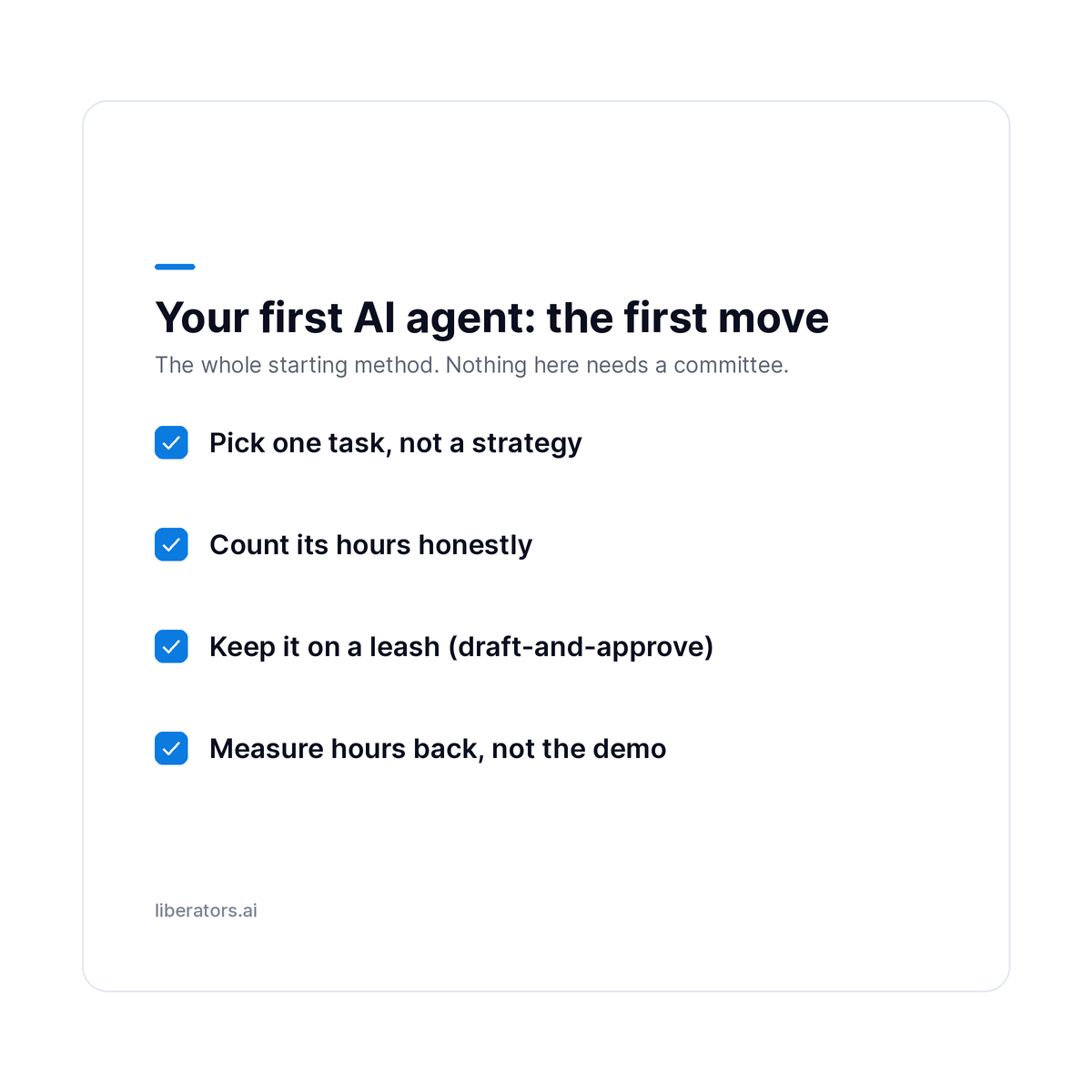 The whole starting method on one card. Nothing here needs a committee.
One thing is missing from that list on purpose: picking the perfect platform. The tools change every month. The method doesn't, and the method is what most advice skips because it's written for enterprises with committees. You don't have committees. You have a Tuesday, and a task that's eating it.
If you want the fuller picture of the technology underneath all of this, our plain-English guide to what AI is covers the ground beneath agents: how the models learn, why grounding in your own data matters, and where AI fits between the systems you already run. If you run a smaller company, AI for small business walks the same method from the owner's side: which task first, and how to count the hours.
AI agents FAQ for business leaders
What is an AI agent in simple terms?
An AI agent is software that completes a task for you instead of just answering a question. It reads a request, looks up what it needs, decides the next step, takes the action, and checks the result, escalating to a person when it should. A chatbot replies; an agent finishes the job.
AI agent vs chatbot: what's the difference?
A chatbot holds a conversation and answers questions, usually through a widget on your site. An AI agent takes action across several steps: it looks things up, updates your systems, and sends the follow-up. The chatbot hands the next step back to you. The agent does the next step, then a person checks it. If a "chatbot" only ever replies, it isn't an agent, whatever it's called.
Is ChatGPT an AI agent?
In its plain chat window, no. It answers, and you do the next step. The same product with tools switched on, browsing, reading files, working a request across several steps, is behaving as an agent for that task. The label follows the setup, not the brand: if it takes actions on your behalf and stops when it should, it's acting as an agent.
How do AI agents work?
They run a short loop: perceive the request and gather context, decide the next allowed step, act on it, then check the result and repeat until the task is done or a human is needed. Unlike fixed automation that follows a script, an agent chooses each step based on what it found, which is why it handles messy, real-world input instead of breaking on it.
What are the 5 types of AI agents?
That's the textbook taxonomy from the classic AI course: simple reflex, model-based, goal-based, utility-based, and learning agents, ordered by how much they reason before they act. It's useful in a classroom and nearly useless in a buying decision. The agents vendors sell today are built on large language models and sit at the goal-based and learning end of that list. For a business leader, the split that matters is the one above: assistant, chatbot, or agent.
Are AI agents safe to let loose on my business?
Not without guardrails, and you shouldn't want them to be. Keep each agent's task bounded, limit what actions it can take, ground it in your real data, and put a human review step on anything that matters. Because agents chain steps, small errors can compound, so start with draft-and-approve and loosen control only once you trust it on a specific job. Accountability always stays with a person.
What do most companies use AI agents for first?
The common first projects are customer support (instant answers to repeat questions from company documentation), sales paperwork (quote and proposal drafting logged to the CRM), and moving data between systems. All three are high volume, low judgment, and easy to measure inside a month. Start where the repetition is loudest in your own operation.
Will an AI agent replace my team?
An agent replaces tasks, not judgment. It takes over the drafting, the retyping, and the repetitive answering, which usually fills a real chunk of each person's week. The decisions, the relationships, and the accountability stay with people. Most companies we work with redirect the recovered hours toward selling and service, the work that was getting squeezed out.
The next step
Take the buzz off it and an AI agent is a straightforward thing: software that finishes the repetitive parts of a task instead of talking about them. You don't need to become an expert in it. You need one repetitive task off your team's plate, proven, and then the next one.
If you want a second pair of eyes on where an agent would pay off in your business, book a free 30-minute AI audit. Thirty minutes, no commitment. If the answer is "you don't need an agent for this yet," we'll say so and tell you what to fix first. Or just reply and tell us what's eating your team's hours. We read every message.
Liberation isn't about working harder. It's about working human.