Two capable assistants, one budget line. Here's how to pick without the hype.
Claude vs ChatGPT is the question every owner asks the moment the team stops treating AI as a toy and starts paying for it. You've seen both names in the same breath a hundred times. What nobody tells you is the answer that matters for a company: not "which one is smarter" in the abstract, but which one earns its subscription in your operation, on your work, with your people using it every day.
This guide answers that. Not for developers comparing them for coding, not for students writing essays. For the person deciding whether to put Claude, ChatGPT, or both in front of a 30-person team. By the end you'll know where each one is stronger, how the plans compare, and a simple rule for when to reach for one over the other. We use Claude heavily ourselves, and I'll be straight about why, without pretending ChatGPT lost a race it didn't lose.
The short version first.
Claude vs ChatGPT: the short answer for a business
Both are excellent. For most companies, the winner is "whichever one your team will open every morning." That sounds like a dodge. It isn't. The gap between the two on everyday business work is smaller than the gap between a team that uses AI daily and a team that installed it and forgot.
That said, a few patterns hold up across the companies we work with:
- ChatGPT is the broader product. It has the largest user base, the widest set of built-in extras (image generation, voice, a big library of shared custom assistants), and it's the one your staff have probably already touched at home.
- Claude tends to win on long documents, careful writing, and following detailed instructions without wandering. When the task is "read these 40 pages and don't make things up," it's the one we reach for.
★ Remember: you are not marrying one vendor. Plenty of teams run both, a paid seat of each for the people who need them. The cost of that is far less than the cost of a week lost to picking the "perfect" one.
What Claude and ChatGPT are, and who makes them
Quick grounding before the comparison, because the names hide who's behind them.
ChatGPT is made by OpenAI. It's the product that put AI assistants on the map in late 2022 and still has the most name recognition by a distance. Under the hood it runs OpenAI's GPT family of models, and the company keeps adding features around the chat box: file uploads, web browsing, image creation, voice conversations, and a marketplace of purpose-built assistants.
Claude is made by Anthropic, a company founded by former OpenAI researchers with a stated focus on safety and reliability. Claude is known for handling very long inputs (Anthropic's own model documentation lists context windows measured in the hundreds of thousands of tokens, with larger windows available), and for producing writing that needs less cleanup.
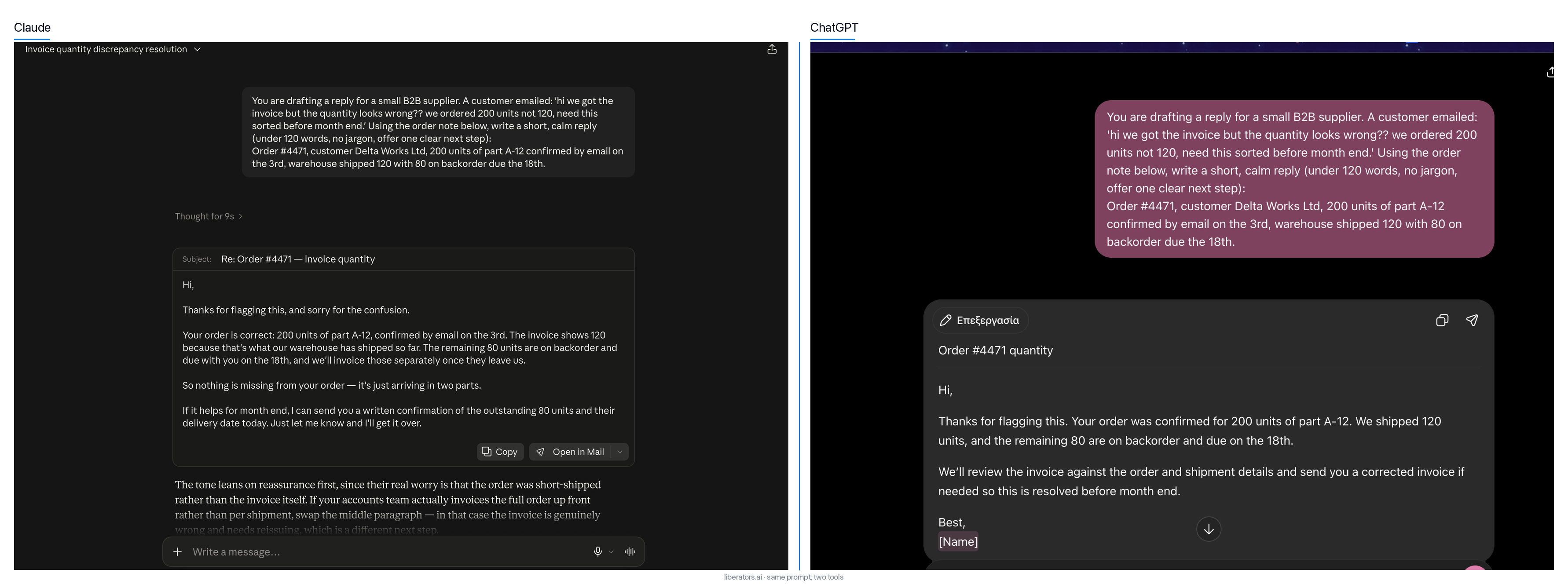 The same real prompt, both tools, no cherry-picking. This is the test that beats any spec sheet.
Neither of these is niche software. According to the Stanford HAI AI Index 2025 report, 78% of organizations reported using AI in 2024, up from 55% the year before. The assistants in this article are a big part of that jump. The question left for a company is which one fits the work in front of you.
ChatGPT vs Claude: where each one is stronger
Compare the two on business tasks rather than benchmarks and clear patterns show up. Here's what we see repeatedly.
Where ChatGPT pulls ahead:
- Breadth of features. Image generation, voice mode, and a huge catalog of ready-made assistants live inside one subscription. If you want one tool that does a bit of everything, this is it.
- Familiarity. Your team likely knows it already. Adoption friction is close to zero, and that matters more than any feature list.
- Ecosystem. More third-party tools, plugins, and tutorials are built around ChatGPT than anything else, simply because it got there first and got biggest.
Where Claude pulls ahead:
- Long documents. Feed it a long contract, a full policy manual, or a quarter of meeting notes and it holds the thread better. This is the single most common reason our clients prefer it.
- Writing quality out of the box. Claude's drafts tend to sound less like a robot and need fewer edits. For proposals, emails, and anything customer-facing, that saves real minutes per document.
- Following instructions precisely. Give it a detailed brief with rules ("keep it under 150 words, no jargon, mention the warranty") and it sticks to them more reliably.
✓ Tip: the fastest way to settle this for your own work is the test in the image above. Take one real, messy task from your week, paste the exact same prompt into both, and compare the two answers. Ten minutes of that beats ten reviews like this one.
Neither list makes the other tool bad. ChatGPT writes fine and handles long text well; Claude keeps adding features of its own. These are tendencies, not walls.
Claude AI vs ChatGPT on the things a business cares about
Set the decision against the criteria that come up in a real buying conversation and it gets easier to reason about. Here's the side-by-side we walk clients through.
| What you're weighing | Claude (Anthropic) | ChatGPT (OpenAI) |
|---|---|---|
| Best-known strength | Long documents, careful writing, instruction-following | Broadest feature set, biggest ecosystem |
| Handling long inputs | Very strong; built around large context windows | Strong, improving with each release |
| Built-in extras | Growing (document work, connected tools) | Wider today (images, voice, assistant marketplace) |
| Team familiarity | Lower; some ramp-up | Higher; most staff have used it |
| Writing that needs little editing | Usually less cleanup | Good, occasionally more generic |
| Business/Team plans | Yes (Team and Enterprise) | Yes (Team and Enterprise) |
| Data used to train the models by default (business plans) | No, per Anthropic's business terms | No, per OpenAI's business terms |
| Our own default | Primary tool for client work | Used alongside, task by task |
Two rows on this table deserve a word, because they're the ones owners worry about most.
Data and privacy. On both platforms' business plans (Team and Enterprise), the vendor states it does not train its models on your content by default. Anthropic spells this out for its commercial products in its data and model training policy; OpenAI publishes the equivalent for ChatGPT Team and Enterprise. That's the important line for a company. The free consumer tiers have looser defaults, which is one more reason not to run sensitive work through a personal free account. Before you standardize on either, ask the vendor two plain questions: "Is our data used to train your models?" and "Where is it stored and who can access it?" If the answer takes more than two sentences, keep asking.
⚠ Caution: the biggest data risk isn't the tool you choose. It's staff pasting customer details into a free personal account on their phone. A paid team plan with clear rules beats an unmanaged free-for-all every time, whichever brand it carries.
Claude vs ChatGPT pricing: how the plans stack up
Pricing follows nearly the same shape on both sides, which makes cost a weak tiebreaker once you're on a paid team plan. Here are the actual sticker prices, not just the ladder names.
USD sticker prices as of September 2026, from Anthropic's pricing page and OpenAI's ChatGPT / Business pricing (plus OpenAI's published consumer tiers for Go / Plus / Pro). Vendors change these — re-check the links before you buy.
| Tier | Claude (Anthropic) | ChatGPT (OpenAI) |
|---|---|---|
| Free | $0 | $0 |
| Individual | Pro: $20/mo ($17/mo if billed annually, $200/year) · Max 5×: $100/mo · Max 20×: $200/mo | Go: $8/mo (US) · Plus: $20/mo · Pro: $200/mo |
| Team / Business (per seat) | Team standard: $25/seat/mo ($20 if billed annually) · Premium seats: $125/seat/mo ($100 annual) | Business Standard: $25/seat/mo ($20 annual) · Business Premium: $125/seat/mo ($100 annual). Min. 2 seats. |
| Enterprise | $20/seat/mo + usage billed at API rates | Custom (sales) |
What that means in practice for a small company:
- Free is for trying it. Not for customer data.
- Individual paid is the everyday seat for one professional — Claude Pro and ChatGPT Plus both sit at $20/month. ChatGPT's cheaper Go tier ($8) is fine for light use; Claude Max ($100 / $200) and ChatGPT Pro ($200) are for people who burn through limits.
- Team / Business is the right company starting point: central billing, shared workspace, and the business data terms above. Both vendors land at $20–$25 per seat per month on the standard seat (cheaper on annual). Premium / Max-style seats jump to about $100–$125.
- Enterprise is where the two diverge. Anthropic publishes a seat price — $20 per seat, with usage billed on top at API rates, so the bill scales with how hard your team works the models. OpenAI's is sales-led. Either way, don't buy it until Team seats are proving hours back.
Cost rarely settles Claude vs ChatGPT on its own. Fit, data terms, and whether people actually open the tool matter more than a few dollars per seat.
✓ Tip: don't buy Enterprise before you've proven the work on a couple of Team seats. The number that matters isn't the monthly price, it's hours saved per seat. A plan that saves one person five hours a week pays for itself many times over, at either vendor's price. A plan nobody opens is expensive at any price.
When to use Claude vs ChatGPT
If you run both, the useful question becomes when to use Claude vs ChatGPT for a given task. Here's the rule of thumb we hand our clients. It won't be right 100% of the time, and that's fine.
| The task in front of you | Reach for |
|---|---|
| Summarize a long contract, report, or manual | Claude |
| Draft a proposal, quote, or client email | Claude |
| Follow a strict brief with lots of rules | Claude |
| Generate an image or a quick visual | ChatGPT |
| Brainstorm broadly, explore lots of angles | Either (ChatGPT if you want volume) |
| Use voice to talk through an idea | ChatGPT |
| Onboard a non-technical staff member to AI | ChatGPT (they likely know it) |
| Analyze a big spreadsheet or dataset dump | Either; test both on your data |
| Anything touching sensitive customer data | Whichever you run on a paid Team plan |
The pattern underneath the table: Claude for careful, long, written work; ChatGPT for breadth, media, and reach. Give it a week of real use and your team will develop their own instincts, which will matter more than any table I can draw.
Claude vs ChatGPT for business: what we tell our clients
When a client asks us to settle this, we don't lead with a brand. We lead with the work. Then, more often than not, we land on Claude as the primary tool, and I want to be straight about why, and about the limits of that preference.
We build a lot of document-heavy systems: proposal drafting, contract summaries, customer support answered from a company's own files. On that kind of work, Claude's strengths (long inputs, less editing, sticking to instructions) map directly to hours saved. The task fits the tool, and that's the whole reason. For a business whose bleeding-hours problem is images, social media, or voice, we'd point the other way without blinking.
Most comparison articles skip this part: the tool is maybe 20% of the result. The other 80% is whether it's connected to your actual data, whether one person owns the rollout, and whether you measure hours back instead of admiring the demo. The support systems we build answer most routine customer questions straight from a client's own documentation, and the model behind them is almost the least interesting decision in the build. Swap Claude for ChatGPT and the result barely moves if the grounding and the process are right. Get those wrong and no brand saves you. That, by the way, is the line between a chat window and an AI agent that finishes the task: the grounding and the loop around the model, not the model itself.
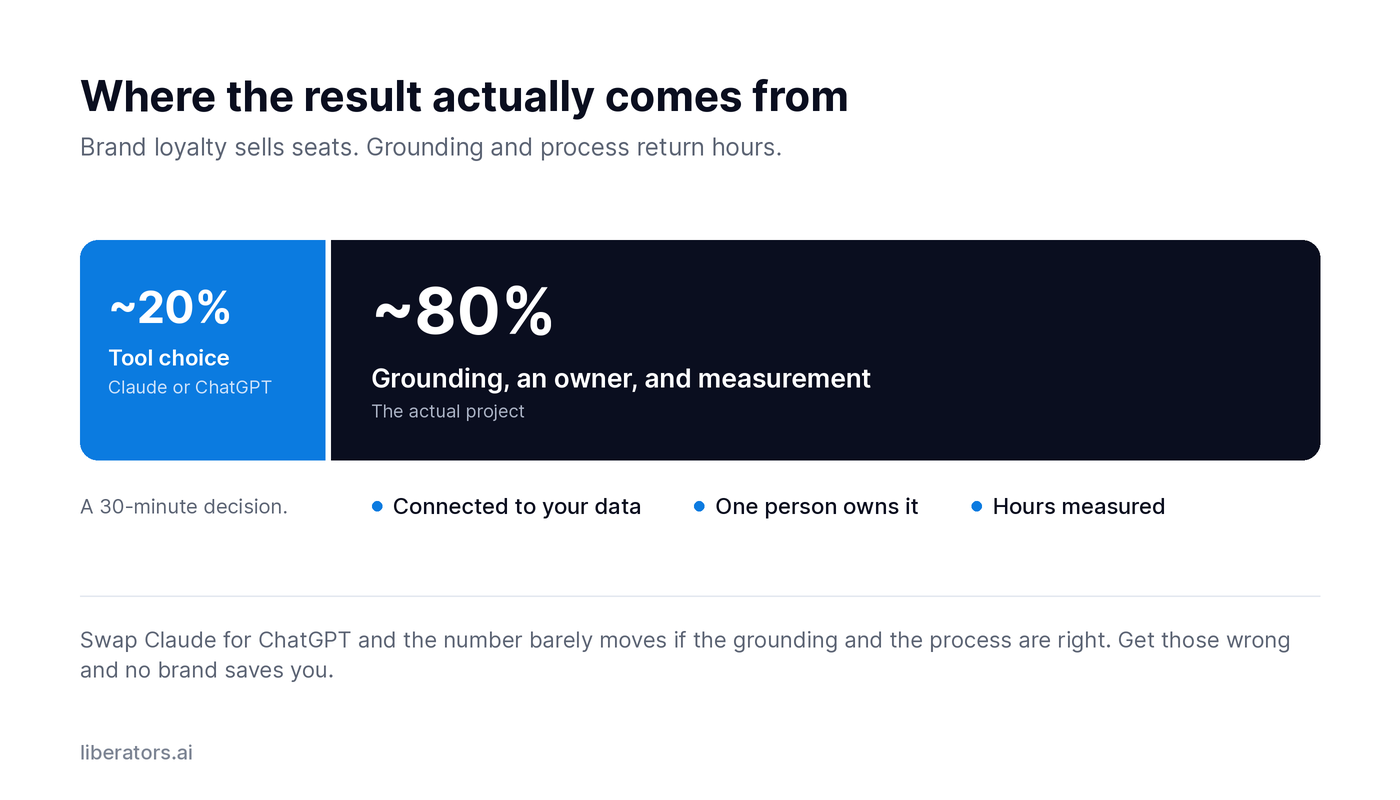 Brand loyalty sells seats. Grounding and process return hours. Put your energy where the number is bigger.
★ Remember: picking the AI assistant is a 30-minute decision. Pointing it at the right task and wiring it into your data is the actual project. Spend your energy accordingly.
If you want the broader lay of the land before you commit, our guide to what AI is for a business covers the fundamentals, and if you're weighing the whole field rather than these two, ChatGPT alternatives and our Claude vs ChatGPT vs Gemini comparison widen the view. For smaller teams specifically, AI for small business is the more practical starting point.
Rolling one out to your team without the chaos
Choosing is the easy half. Getting a team to use the thing is where projects stall. A short playbook, drawn from rollouts that stuck:
- Buy Team seats, not free accounts. You get the business data terms, central billing, and shared workspaces. It also signals that this is real, not a side experiment.
- Pick one task to standardize first. "Everyone drafts proposals here" beats "use AI for whatever." One task gives people a reason to open it on day one.
- Name an owner. One person who fields questions, shares good prompts, and reports what's working. Rollouts without an owner die quietly in week three.
- Write three ground rules. What can and can't be pasted in, which plan to use, and who to ask. Three lines on a wiki page, not a policy binder.
- Measure hours, not enthusiasm. After two weeks, ask the obvious question: did the proposal go out in twenty minutes instead of two hours, and did anyone have to fix it? If yes, expand. If no, change the task or the setup.
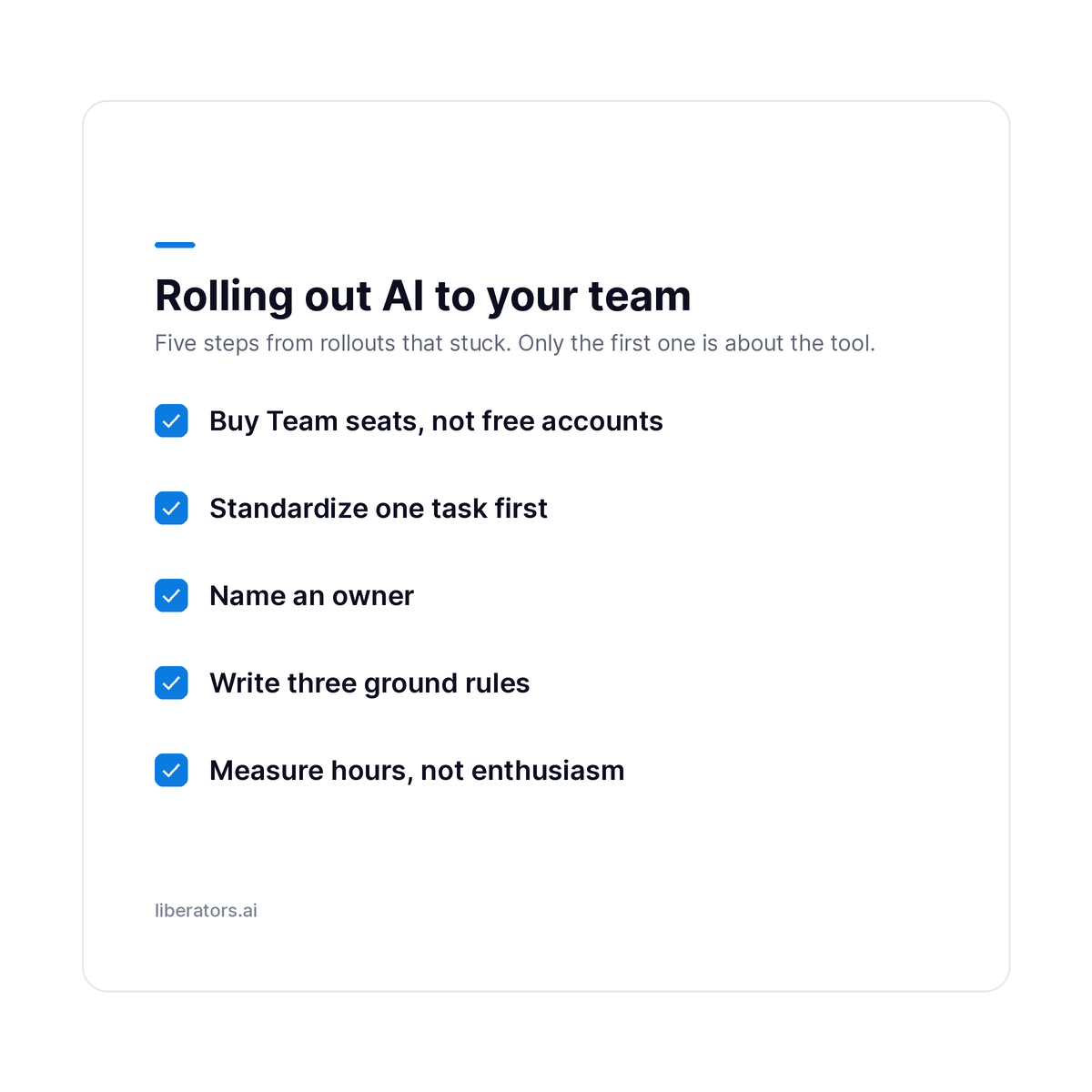 The rollout on one card. Notice that only step one is about the tool. The rest is about people and process.
Do this and the whole question shrinks to what it should be: a footnote in a project that's about giving your team back their week.
Claude vs ChatGPT FAQ for business owners
Is Claude better than ChatGPT?
For long documents, careful writing, and following detailed instructions, most people find Claude better. For breadth of features, image and voice, and sheer familiarity, ChatGPT often wins. So "is Claude better than ChatGPT" has no single answer. It depends on the task. Test both on one real job from your week and let the results decide, rather than trusting anyone's leaderboard.
What can Claude do that ChatGPT can't?
Very little in absolute terms; the two keep closing each other's gaps within months. The differences are tendencies. Claude tends to hold a long document together and follow a detailed brief with less drift, and its first drafts usually need less editing. ChatGPT has the wider built-in feature set, images and voice included. The "I switched to Claude" posts that fill this search result mostly cite the same two things, writing quality and long documents. If that's your work, that's your answer. If your work is media and breadth, it isn't.
When should I use Claude vs ChatGPT?
Use Claude when the work is long, written, and detail-heavy: contracts, proposals, policy summaries, anything with a strict brief. Use ChatGPT when you want images, voice, a broad brainstorm, or when a non-technical colleague already knows it. If you're only going to pay for one and your work is document-heavy, Claude is the safer default. If it's media-heavy, ChatGPT is.
How much do Claude and ChatGPT cost?
Both follow the same four-tier structure: a free tier, an individual paid plan (Claude Pro, ChatGPT Plus), a per-seat Team plan, and custom Enterprise pricing. Prices shift regularly, so check each vendor's current page before you buy: Anthropic publishes current Claude pricing by tier, and OpenAI lists ChatGPT's equivalent tiers. For a company, start on a Team plan for the business data terms, not a free account.
Can I use both Claude and ChatGPT?
Yes, and many teams do. Buy the people who write and analyze all day a Claude seat, and give the people who need images, voice, or broad exploration a ChatGPT seat. The combined cost is small next to the hours a well-used assistant returns. Running both also lets each person build a feel for which tool suits which task.
Is my company data safe with Claude or ChatGPT?
On both vendors' business plans (Team and Enterprise), the company states it does not train its models on your content by default. The real risk sits elsewhere: staff pasting sensitive data into free personal accounts. A paid Team plan with three clear ground rules is safer than an unmanaged mix of free logins, whichever brand you pick.
Which one does Liberators use?
We use Claude as our primary tool because most of our client work is document-heavy, where its strengths pay off directly. We reach for ChatGPT when a task calls for it. We match the tool to the work, and we'd recommend you do the same rather than copy our default.
What to do next
Set the brand loyalty and the leaderboard screenshots aside and Claude vs ChatGPT is a small decision wearing a big costume. Both are good. The one that helps your business is the one aimed at the right repetitive task, connected to your data, and opened every morning by a team that knows why.
If you're not sure which task to point it at, that's the conversation worth having, and it's a short one. Book a 30-minute AI audit. No commitment, no pitch. If the answer turns out to be "your problem isn't the tool, it's the process," you'll hear that in the first ten minutes. Or reply and tell us what's eating your team's hours; we read every message.
Liberation isn't about picking the smartest robot. It's about working human.