The whole question for a 20-to-60-person company isn't "which tool." It's "which task, and what does it save us this month."
AI for small business gets talked about like it's one decision: pick a tool, flip a switch, watch the magic happen. It isn't. For a company with 20 to 60 people, the useful question was never "which tool" but "which task, and what does it give back this month." This guide is for the owner asking where to start, and what pays off first, without a six-month project or a consultant who bills by the syllable.
You've probably already tried something. Someone on the team uses ChatGPT to draft emails. Maybe you tested a tool for a week and quietly stopped. That's the normal starting point, and it's exactly why "where do I start" is the wrong first question. The right one is "where is my company bleeding the most hours, and can software carry that."
Let's answer both.
What "AI for small business" means in practice
Past the conference talk, AI for small business is simple: artificial intelligence here means software that reads, writes, and decides within limits you set, pointed at the repetitive tasks your team already does by hand.
No robot workforce. No strategy pivot. A capable assistant that reads a rambling customer email and pulls out the order number, drafts the quote in your company's format, or answers the same eight questions your inbox gets forty times a day. The work doesn't change. Who does the repetitive first pass does.
This stopped being a fringe experiment a while ago. According to the Stanford HAI AI Index 2025 report, 78% of organizations reported using AI in 2024, up from 55% the year before. And it isn't just big companies: the U.S. Chamber of Commerce's 2025 Empowering Small Business report found that 58% of small businesses now use generative AI, up from 40% in 2024 and more than double the 23% of 2023.
Those numbers hide something. Most of that adoption is one person using ChatGPT to write the occasional email. That's fine, and it's a long way from AI taking a task off the company's plate, measurably, every week. The gap between "we use AI" and "AI gave us back thirty hours a month" is the whole subject of this article.
★ Remember: the goal is not to "use AI." The goal is one repetitive task off your team's plate, proven, then the next one.
The real question isn't "which AI tools for small business?"
Search "ai tools for small business" and you'll drown in top-ten lists. Every one of them is out of date within a quarter, because the tools change monthly and the lists are written to collect clicks, not to solve your Tuesday.
The tool matters far less than the method. Two small businesses can buy the identical software and get opposite results, because one pointed it at a high-volume repetitive task and measured the hours, and the other pointed it vaguely at "innovation" and cancelled the subscription in month three. Same tool. The targeting was the whole game.
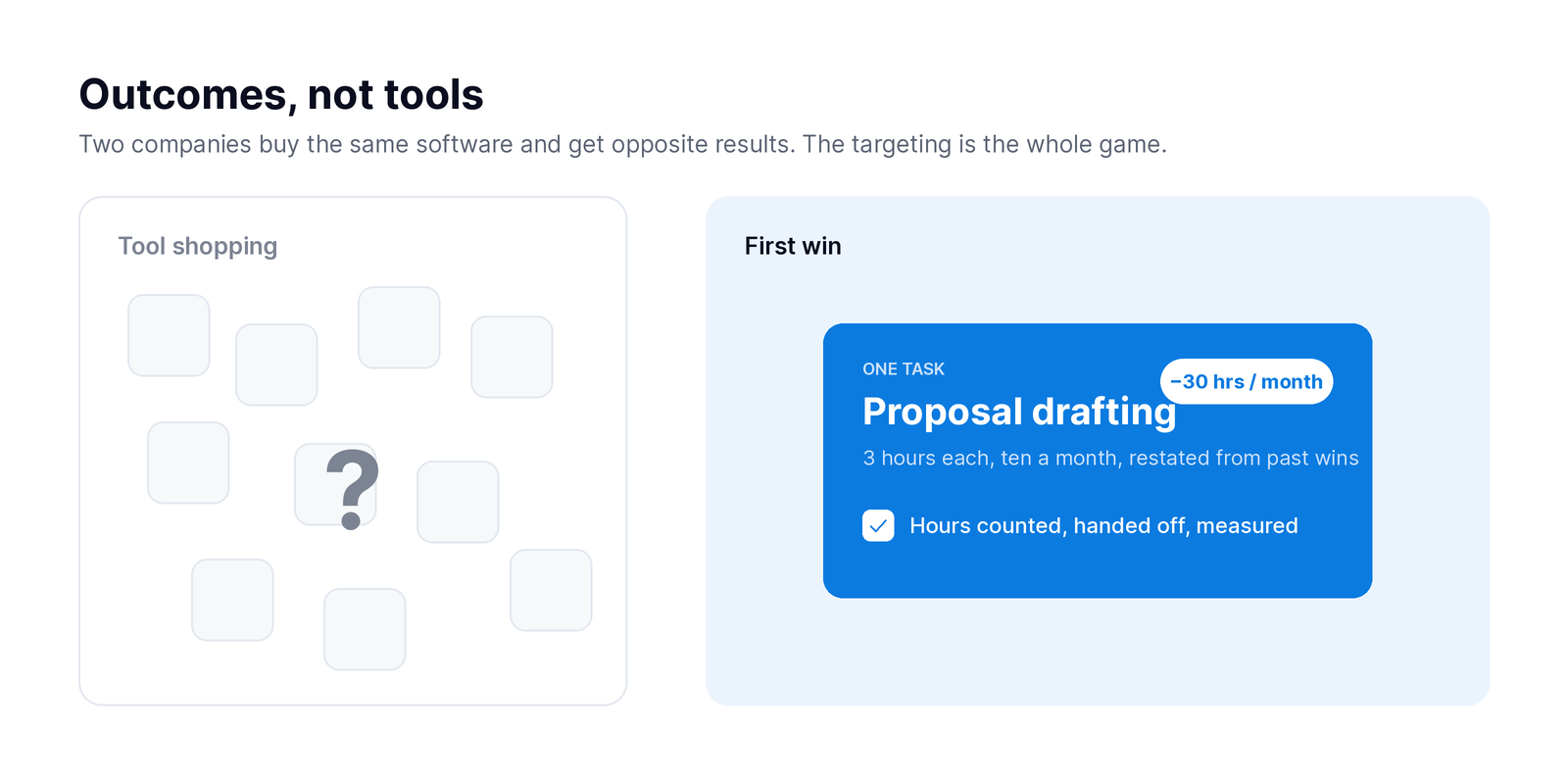 Tool shopping is the trap. The move that works is smaller and duller: one repetitive task, hours counted, handed off.
This is why, in our own work, we don't lead with a tool. We ask what's eating the week, and we point software at the loudest source of repetition. The tool is a means. The outcome, thirty hours a month back on proposal drafting, an inbox that answers itself overnight, is the thing you bought. A tool that saves nobody any time is a line item, not a win.
✓ Tip: when a vendor opens with the product instead of your problem, you're being sold to, not helped. The same test applies to an AI consultant for small business: the first question from anyone worth their fee is "which task of yours is this taking over, and how will we check it worked."
Where AI pays off first: the four areas
Almost every first win for small businesses lands in one of four areas. They map cleanly to the parts of a company where repetitive language-and-data work piles up: sales, marketing, customer support, and operations.
| Area | The manual version | The first win AI takes over |
|---|---|---|
| Sales | Writing each proposal from scratch, updating the pipeline by hand, forgetting the follow-up | Drafts quotes and proposals from your past wins, keeps the pipeline current, queues the follow-up |
| Marketing | Content in bursts when someone finds time, then silence for a month | Steady first drafts in your voice, adapted per channel, ready for a human to approve |
| Customer support | The same questions answered one at a time, during office hours only | Instant answers from your own documentation, at 2 a.m. too, with the hard cases routed to a person |
| Operations | Data retyped from email into the system, then into the courier portal, then a spreadsheet | Information passed between systems with nobody playing human clipboard |
Notice what these have in common. Every one is work your team already does, in hours you already pay for. That's the point. You're not adding a new capability, you're taking a boring, repeated chore off a person who has better things to do.
In our own support builds, the routine questions get answered automatically, straight from the client's documentation, and the ones that deserve a human go to a human. Repetition to the machine, judgment to a person. That split holds across all four areas.
Not sure which of the four is costing you the most? That's a normal place to be stuck, and it's a short conversation rather than a big project.
How to pick your first win
Here's the method, drawn from the projects that stick and the ones that flop. It's four steps, and none of them involves picking a tool first.
1. Pick one task, not a strategy. The projects that fail start with "let's become an AI-driven company." The ones that work start with "quotes take three hours each and they shouldn't." High volume, low judgment, repetitive to the point of boredom. One task.
2. Count its hours honestly. Ask the person who does the work, not the org chart. Multiply hours per instance by instances per month. If a proposal takes three hours and you send ten a month, that's thirty hours, most of a working week, spent restating things your company has written a hundred times. If the total doesn't make you wince, pick a different task.
3. Pilot in weeks, not quarters. A first working setup should be live in two to four weeks. That's the timeline we build to, and it's a fair benchmark for anyone you talk to. Anything that needs six months before it shows value is a redesign project wearing an AI badge. Start narrow.
4. Measure hours back, not the wow factor. The demo is not the product. The measurement is the following Tuesday: did the quote go out in twenty minutes instead of three hours, and did anyone have to fix it afterward? If yes and no, expand. If not, stop, and you've lost weeks, not a year.
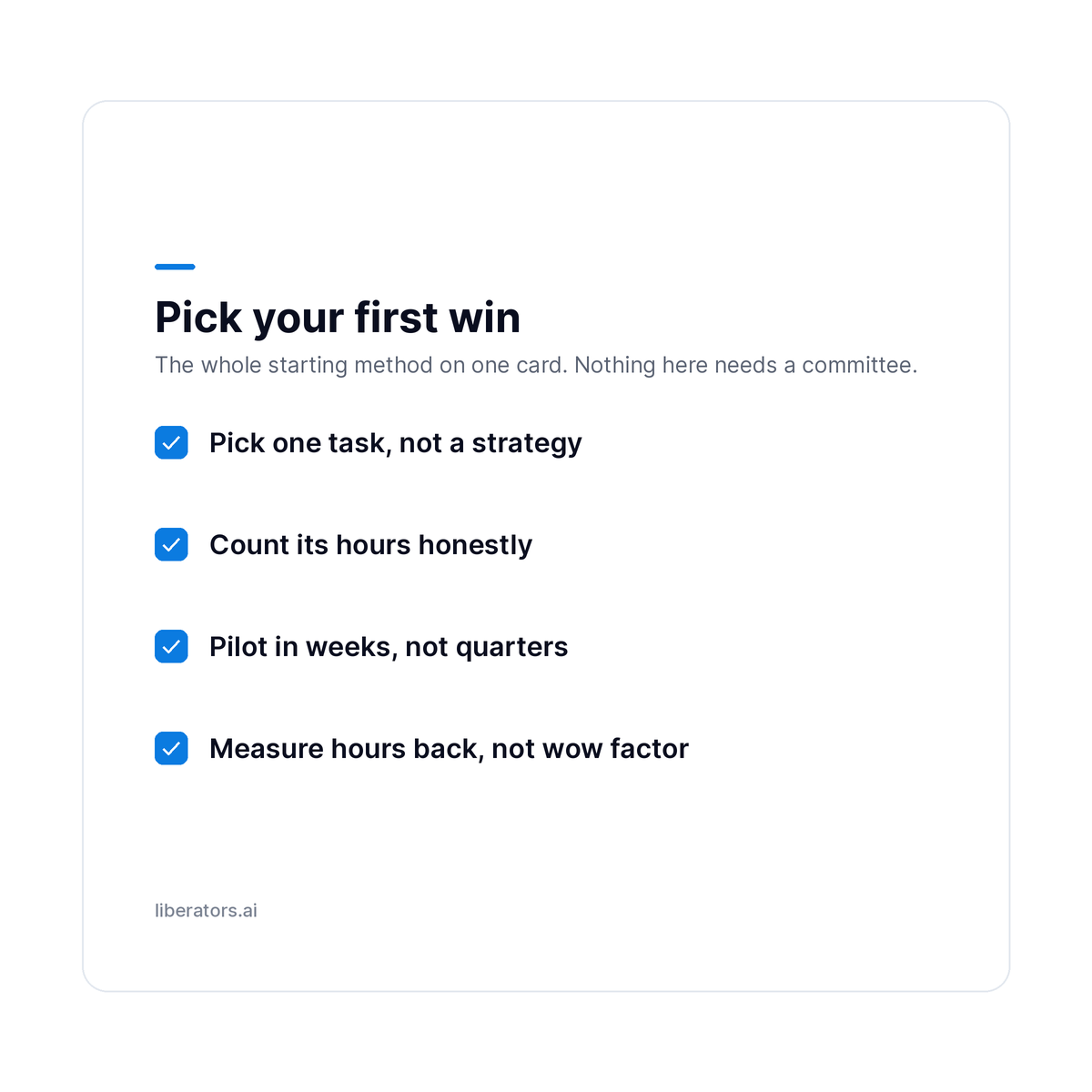 The whole starting method on one card. Nothing here needs a committee, because you don't have one.
A task worth starting with shows three signs, and a strong candidate has all three:
- It repeats. Weekly at least, ideally daily. A task that happens twice a year isn't worth the setup, no matter how annoying it is.
- It lives in language or data. Emails, documents, messages, spreadsheet rows. If the work is mostly reading, writing, or moving information, software can carry it. If it's mostly physical or relational, it can't.
- A knowledgeable person can check the output in a minute. Fast checking is what makes the whole thing safe. If reviewing the AI's work takes as long as doing the work, you've automated nothing.
Run your own operation through that filter and you'll usually find three or four candidates before your coffee's cold. That short list, ranked by hours, is a better plan than most paid strategy decks. Here's a rough sort to get you going:
| Task | How often it repeats | Judgment needed | Good first candidate? |
|---|---|---|---|
| Answering repeat customer questions | Daily | Low | Yes, strong |
| Drafting quotes and proposals from inquiries | Weekly or more | Low to medium | Yes |
| Chasing invoices and sending follow-ups | Weekly | Low | Yes |
| Retyping data between systems | Daily | Low | Yes |
| Producing first drafts of marketing content | Weekly | Medium | Yes, with human review |
| Hiring and promotion calls | Occasional | High | No |
| Pricing strategy and negotiation | Occasional | High | No |
| Signing off legal or financial commitments | Occasional | High | No, stays human |
Best AI for small business: categories, not brand names
So which one do you buy? Ask "what's the best AI for small business" and the truthful answer is that there isn't one, because the right tool depends entirely on the task you picked in the last section. Naming a brand here would age like milk. Naming the category won't.
Think in categories, not products. Most of what small businesses need falls into a handful of buckets:
- General assistants (the ChatGPT / Claude / Gemini class). Good for drafting, summarizing, and answering ad-hoc questions. This is where nearly everyone starts, and where most small businesses stall, because a general assistant knows the world but nothing about your business until you connect it to your own data.
- Support and answering tools. Software, increasingly an AI agent, that answers customer questions from your documentation, day and night. This is the highest-volume, fastest-payback category for most small businesses.
- Sales and proposal tools. Draft quotes, keep the pipeline current, queue follow-ups from your past deals.
- Content and marketing tools. First drafts of posts, emails, and pages in your voice, for a human to approve.
- Operations and data tools. Move information between your systems so nobody retypes it.
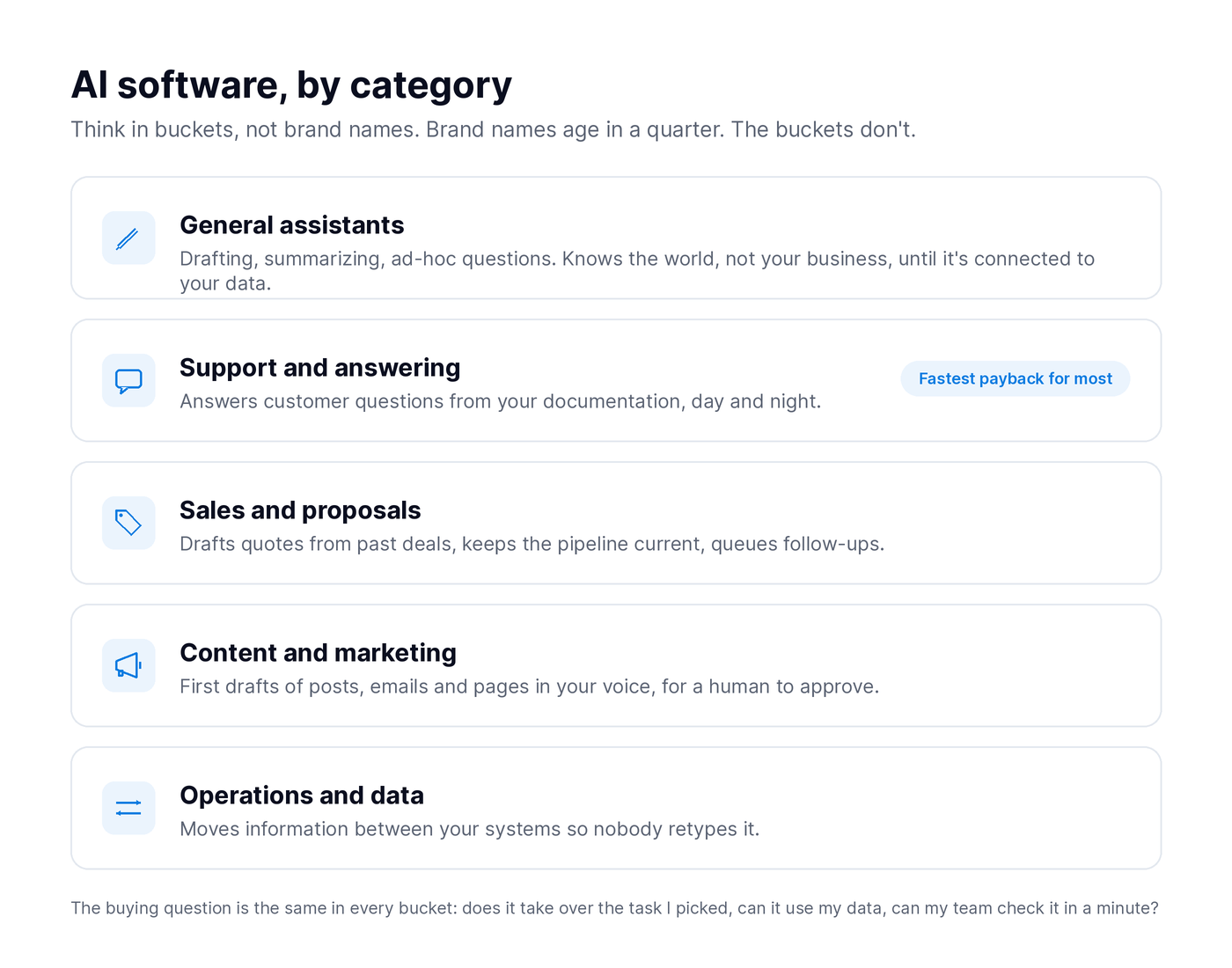 Think in categories, not brand names. Brand names age in a quarter. The buckets don't.
When you evaluate any AI software for small business in one of these buckets, the buying question is the same across all of them, and it isn't about features. Ask: does this take over the specific task I picked, can it be grounded in my own data, and can my team check its output in a minute? A tool that scores yes on all three is the best AI tool for a small business regardless of which logo is on it. One that scores no is a subscription you'll cancel.
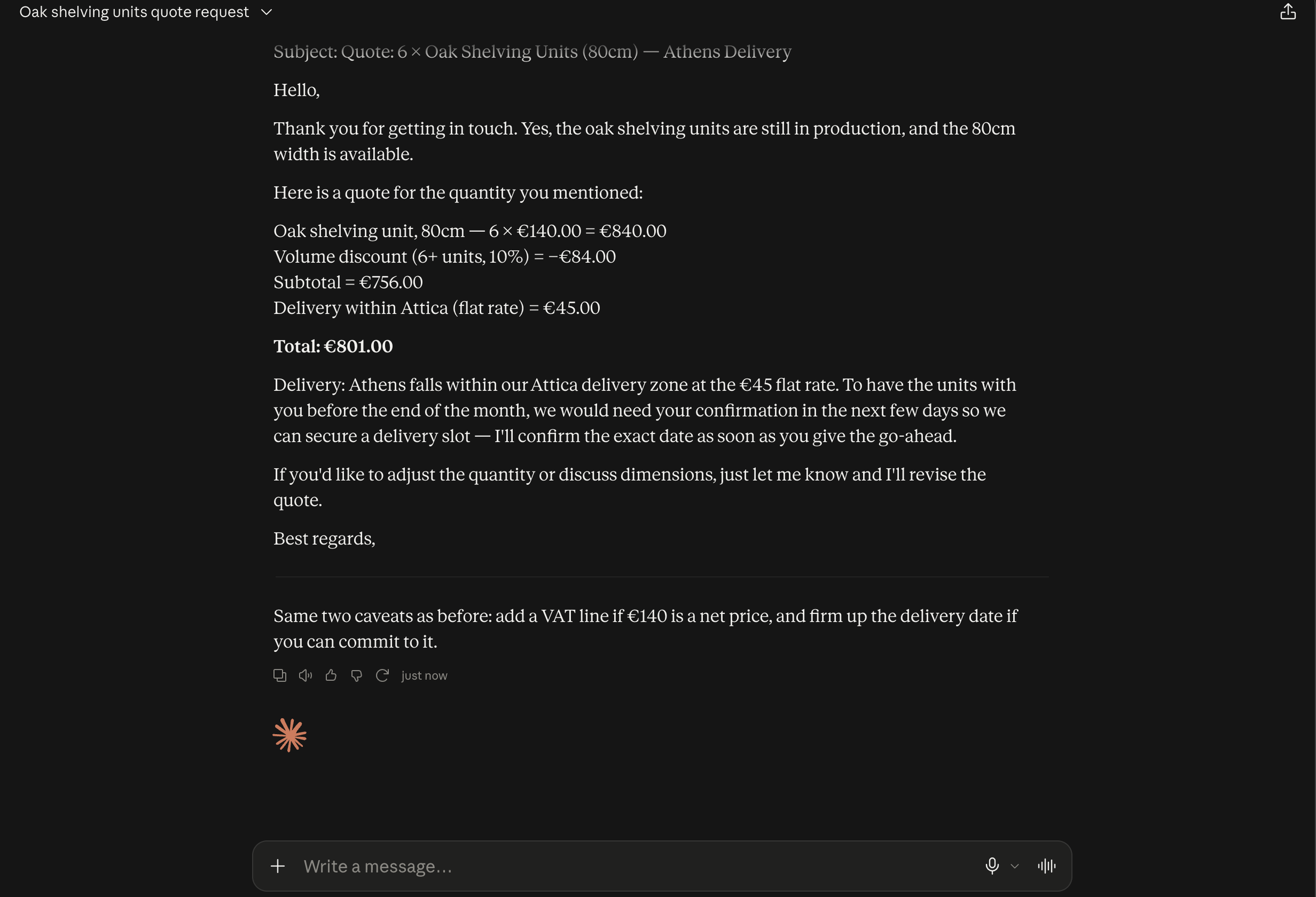 A concrete first win: a messy customer inquiry in, a clean drafted quote out, in seconds. This is what "pays off first" looks like in practice.
⚠ Caution: roundups of the best AI tools for small business are as likely to be ranked by affiliate payout as by fit. Trust the task, not the list. The right tool is the one that clears the loudest repetitive job off your team, proven on your own numbers.
One more thing the pricing page won't tell you: connecting a tool to your documents is a read arrangement, not a donation. Whether a provider trains its models on your data is a contract term, and any serious setup states it in writing. Two questions settle it on a vendor call: "Is our data used to train your models?" and "Where is it stored, and who can access it?" If the answers take more than two sentences, keep shopping.
When a small business should not invest in AI yet
No vendor will volunteer this: some small businesses shouldn't spend a cent on this yet. We'd rather tell you now than invoice you for discovering it in month three.
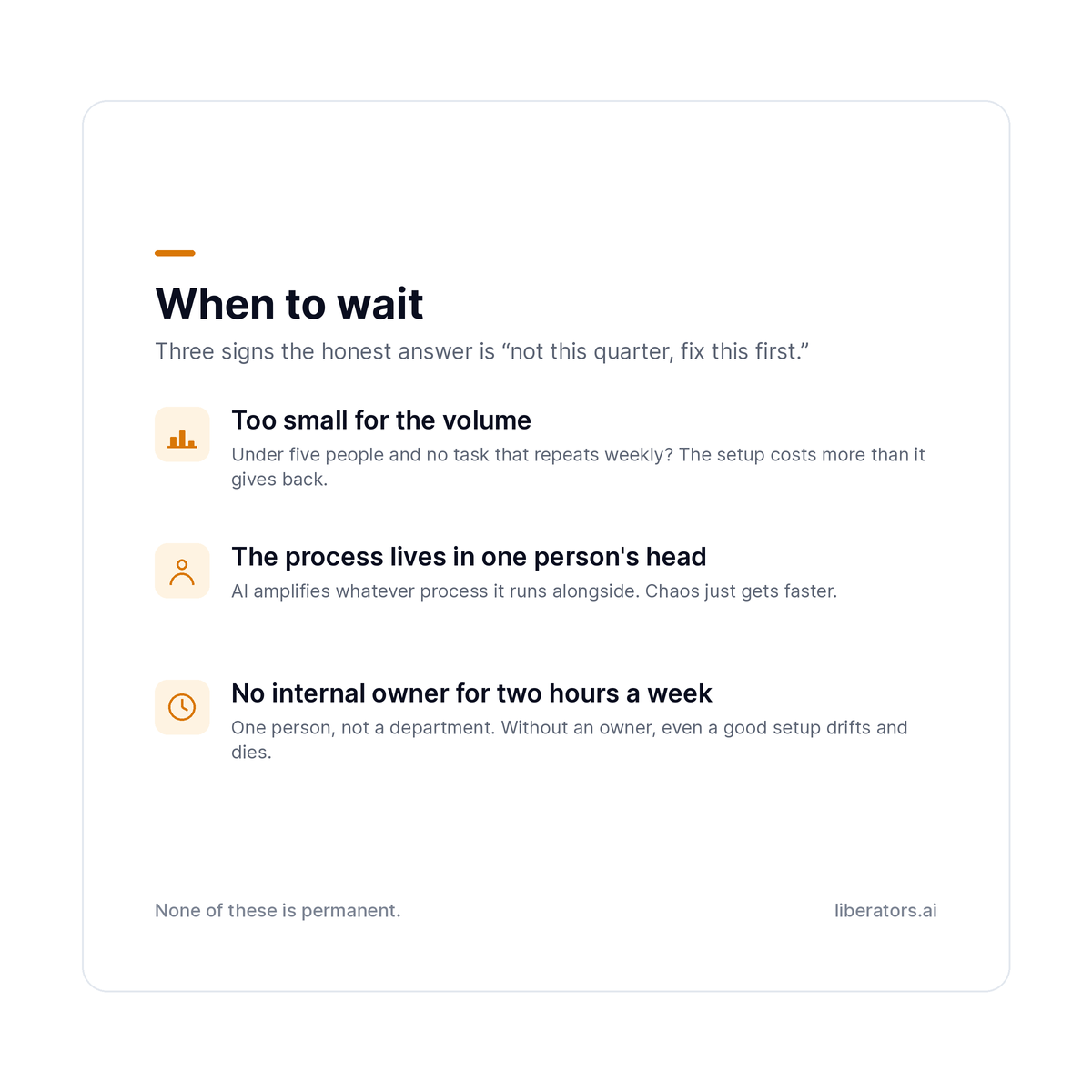 Three reasons to wait. None of them is permanent, and spotting one now saves a wasted quarter.
Wait, and fix the underlying thing first, if any of these are true:
- You're too small for the volume. Under five people with no task that repeats weekly? The setup costs more time than it gives back. Come back when a chore is genuinely eating your week.
- Your processes live in one person's head. AI amplifies whatever process it runs alongside. If your quoting process is chaos, you'll get chaos faster. Sometimes the right first project is fixing the process, with no software involved at all.
- Nobody internally can own it. A first project needs one person who can give it two hours a week for a month. Not a department, one person. Without an owner, even a good setup drifts and dies.
None of this is a permanent no. It's a "not this quarter, and here's what to fix first." AI multiplies what's already there, and multiplying a mess just gets you a bigger mess.
If you read that list and none of it stung, you're in a good spot to start. If one of them did, you just saved yourself a wasted quarter.
FAQ: AI for small business
What is the best AI for small business?
There's no single answer, and anyone who gives you one is guessing or selling. The best AI for small business is whatever clears the loudest repetitive task off your team, can be grounded in your own data, and produces output a person can check in a minute. Pick the task first. The tool follows from it, not the other way around.
How can AI be used for small businesses?
In four places, nearly always: sales paperwork (quotes and proposals drafted from past deals), marketing (steady first drafts in your voice), customer support (repeat questions answered from your own documentation, at any hour), and operations (data moved between systems without retyping). Small businesses that get a first win pick one of the four, the one eating the most hours, and prove it there before widening.
What AI tools should a small business start with?
Start with the category that matches your biggest source of repetition, not the most hyped product. For most small businesses that's customer support (answering repeat questions from your own documentation) or sales paperwork (drafting quotes and proposals). Both are high volume, low judgment, and show measurable hours back within a month.
How much does AI software for small business cost?
Running costs have collapsed. The Stanford AI Index 2025 puts the drop in inference cost for a GPT-3.5-level system at over 280-fold between November 2022 and October 2024. Most AI software for small business is now priced like any other monthly subscription, per seat. Budget stopped being the barrier. Pointing it at the right task, and owning the project internally, is the hard part now.
Is there a single best AI tool for small business?
No. The best AI tool for small business depends on which task you're handing off. A tool that's perfect for answering support questions is useless for retyping data between systems. Match the tool to the one task you picked, judge it on hours saved, and ignore roundup rankings that don't know your business.
How long before AI pays off in a small business?
For a focused first project, a working setup should be live in two to four weeks, and the payoff shows up on the very next cycle of that task. Broad "AI everywhere" programs take far longer because they're process-redesign programs in disguise. Start narrow, prove the hours come back, then widen. Distrust any timeline that can't show value inside a quarter.
Do I need a technical person to use AI in a small business?
Not to start. You need one non-technical owner who understands the task and can spare two hours a week to check the output for a month. The technical setup can be handled for you. What can't be outsourced is knowing which task matters and judging whether the result is good enough to trust.
The honest next step
The whole thing in one breath: AI for small business isn't a tool decision, it's a targeting decision. Find the repetitive task that's quietly eating a chunk of someone's week, count its hours, pilot a fix in weeks, and measure whether the hours came back. Then do the next one. The same game at 15 people or at 60.
If you want a second pair of eyes on where to start, book a free 30-minute AI audit call. Thirty minutes, no commitment, and if the honest answer is "you don't need us yet, fix this first," that's exactly what you'll hear. You can also start on your own: our plain-English guide to what AI is covers the fundamentals with no jargon and no sales deck.
Liberation isn't about working harder. It's about working human.